
Computed Tomography (CT) scan
If you have had an ultrasound that has shown a suspicious lesion (possible cancer) in your liver, you may be referred for a CT scan to provide more information.
Sometimes a CT scan will confirm the diagnosis of liver cancer. It may be used to look for cancer that has spread outside the liver (metastatic disease). A CT scan can provide greater detail than ultrasound.
What is a Computed Tomography (CT) scan?
A CT scan uses X-rays to create detailed 2D or 3D images of the area it is looking at inside your body. A special dye called contrast, which contains iodine, is injected through a vein in your arm or hand to help highlight blood vessels and other structures.
When looking for liver cancer, you will usually have either a triphasic or quad-phase CT of your chest, abdomen and pelvis.
- Triphasic means the scan is done in 3 phases (sections), usually before, during and after you have contrast injected through a vein in your arm or hand.
- Quad-phase simply adds another phase (4 phases or sections) and allows an extra layer of assessment. Not all centres will have quad phase imaging.
What happens during a CT scan?
 The CT scan itself takes about half an hour but you will probably be at the centre for around 2 hours. If you are having a scan of your abdomen (belly) you will be asked to fast for some time before your scan, but if you are having a scan just of your chest you won’t have to fast. You may also be asked to drink an amount of water in the hour or so before your scan.
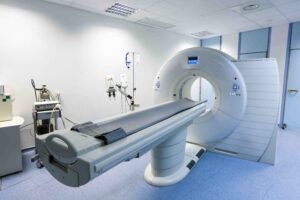
The CT machine looks like a big doughnut, with a tube that rotates around inside it. You will be asked to lie flat on your back, sometimes with your arms above your head. You will need to keep very still and follow instructions to breathe normally or hold your breath. While you are in the machine the person conducting the scan (radiographer) will give you instructions. You will lie on a narrow table that slides into the machine, and you will hear some noises as the machine operates. Even though you will be on your own in the room, the radiographer and other staff are close by and will communicate with you throughout your scan.
The iodine contrast that is injected can give you some short-term side effects which are not dangerous. These are:
- A warm, flushing feeling in your body or around your abdomen (belly) and groin. This can last for about 20 seconds
- A warm sensation around your bladder which can make you feel like you are passing urine
- A metallic taste in your mouth.
What are the risks of a CT scan?
Contrast reaction
Some people have an allergic reaction to the contrast dye. If you know you are allergic to iodine, you must let your doctor and other radiology staff know so they can give an alternative contrast. Sometimes they will do a scan with no contrast. Radiology departments are well equipped to deal with any allergic reactions that might happen.
- Mild reaction happens in up to 1 out of every 100 people. This can include flushing, nausea, itchy skin, headache, vomiting and rash. This reaction could be delayed (happens after you have had the scan) however is not dangerous and will usually go away without treatment. If you have ever had this reaction, you must let staff know if you go for another CT scan so that you can be monitored more closely.
- Moderate reaction includes vomiting, rashes, chest tightness and feeling breathless. Your face and throat might swell up. The doctors and nurses will manage this, but if you have any of these symptoms after your scan you must attend an emergency department.
- A severe reaction is very rare (happens in less than 1 in every 100,000 people) but can be life threatening. This could involve an anaphylactic reaction, which is a severe, rapid allergic reaction where you may stop breathing or go into cardiac arrest.
If you ever experience either a moderate or severe reaction you should not have that contrast again.
Radiation risk
You are exposed to a small amount of radiation when you have a CT scan. Excessive exposure to radiation can increase the risk of cancer, but the amount for a CT scan is not excessive and the benefit of an accurate diagnosis outweighs the risk. However, to avoid exposing an unborn child to radiation, CT scans are not usually performed on pregnant women unless medically necessary. You must tell your doctor or the staff at the radiology clinic if you are or think you may be pregnant.
After your scan, you may need to remain in the radiology centre for a period of time if you have had contrast, to make sure you aren’t having a reaction. Make sure you drink lots of water in the following 24 hours. The contrast is passed out through your urine.
How much does a CT scan cost?
If you have your CT scan in a public hospital you should not have to pay, if you have a Medicare card. In private radiology centres the cost can vary, if you have private health cover it may decrease the cost. You should talk to your doctor about the best option for you.
References
HealthDirect. CT Scan <https://www.healthdirect.gov.au/ct-scan>
NSW Government Agency for Clinical Innovation. CT scans with or without contrast <https://aci.health.nsw.gov.au/__data/assets/pdf_file/0003/570171/ACI-Imaging-CT-scan-consumer-Information.pdf>
RadiologyInfo.org. Abdominal and Pelvic CT <https://www.radiologyinfo.org/en/info/abdominct>
Reviewed Jan 2026