
Magnetic Resonance Imaging (MRI)
MRI can help to diagnose liver cancer if an ultrasound has shown up a suspicious lesion.
What is Magnetic Resonance Imaging (MRI)?
Magnetic resonance imaging (MRI) is a medical imaging technique that uses a strong magnetic field and computer-generated radio waves to create detailed images of the organs and tissues inside your body.
A contrast (special liquid) is injected through a vein in your arm, which will help to highlight your liver and any abnormal areas within it. The MRI can show detailed images of your liver structure (size and shape), blood flow, and assess if any tumours are having an effect on nearby blood vessels or the bile duct – this could help to determine treatment options.
Why do I need an MRI?
An MRI will be used in some centres if an ultrasound has shown a suspicious lesion, or ‘lump’ in your liver. The MRI can help to diagnose a liver cancer and can also show if the cancer has spread into any of the veins in the liver, particularly the portal vein. It can mean that a biopsy is not always necessary to confirm the diagnosis.
How do I prepare for an MRI?
An MRI scan of your liver takes 30 to 60 minutes. You will need to fast for up to 4 hours before your scan.
Even though you are not exposed to radiation during an MRI scan, there are important safety concerns that you need to be aware of.
- The strong magnetic fields used during an MRI can attract any metal objects that you have in or on your body. Therefore, you must remove all jewellery, piercings, skin patches, hair pins and makeup and hair spray. You will need to leave any of these belongings as well as your mobile phone and wallet/credit cards outside the scanning room.
- You will need to fill out a safety form before every MRI you have, to make sure nothing has changed since your last scan.
- Pacemakers, aneurysm clips, heart valve replacement, cochlear implants, metal foreign bodies (including metal fragments in your eye), magnetic dental implants and neurostimulators can all cause harm or be damaged – you must let staff know if you have any of these things, as MRI may not be safe for you. Some implants are safe to go into the MRI machine – you should bring documentation (such as the serial numbers) about any implants you have so the staff can check.
If you have kidney disease you may not be able to have contrast – please let the staff know.
What happens during an MRI?
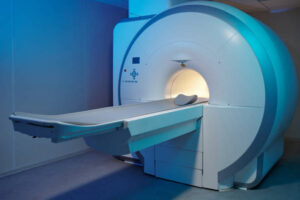
The MRI machine is like a big box with a tunnel through the middle of it. You will lie on a narrow table which goes into the tunnel. You will be given a call bell if you need any help. The MRI machine is very loud during the scan, and you will be given headphones or earplugs to wear. Sometimes you may be able to listen to music to block out the noise.
If you get claustrophobia, you may find the MRI very uncomfortable. Discuss this with staff when your appointment is made, and you may be able to have a sedative to help you relax more during the scan.
You will need to lie very still while the MRI is being done. Between the scans you will be able to talk to the radiographer. You will have to hold your breath at some points and you will be instructed when to do this, and when you can breathe normally. It is really important to follow these instructions, as movement and breathing can affect the images and make them blurry, which means it is hard for the doctors to assess your liver properly.
What are the risks of MRI?
MRI is a safe procedure, as there is no radiation exposure. The main risks come from implants or metal objects that should not be going into the scanner. If you enter the scanner with unsafe objects, the strong magnets can make these objects move or cause severe burns or injuries. This is why you always have to complete the safety questionnaire, even if you have done it many times before.
There is a very small risk of an allergic reaction to the contrast that is used. If you have any signs of an allergic reaction, the staff will treat and monitor you.
How much does an MRI cost?
The cost of an MRI varies depending on where you have it done. If you have an MRI in a public hospital you should not have to pay, if you have a Medicare card. Medicare will cover a portion of your MRI scan in private practice, however you may have to pay the out-of-pocket fee. If you have private health insurance you should check to see if they will cover any of the cost. You may be eligible for 1 bulk-billed MRI scan each year if you have risk of liver cancer and have a suspicious lesion on an ultrasound.
References
I-MED Radiology. MRI Scan <https://i-med.com.au/procedures/mri-scan#gsc.tab=0>
Magnetic resonance imaging for the diagnosis of hepatocellular carcinoma in adults with chronic liver disease. Cochrane Database Syst Rev. 2022 May 6;2022(5):CD014798. doi: 10.1002/14651858.CD014798.pub2.
Reviewed Jan 2026